
The History and Breeds of Hunting Dogs
The hunting dog has a very long history. It belongs to one of the groups of breeds selected by humans to assist with hunting.
The art of hunting is one of the world’s oldest traditions and has been practised by humans in countless ways. It involves capturing or killing wild animals using appropriate tools, particularly weapons, and has enabled humanity to survive over the millennia.
The first indirect reference to hunting appears in Genesis (1:26):
“And God said: Let us make man in our image, in our likeness, and rule over the fish of the sea and the birds of the sky, over the cattle, over all the wild beasts and all the reptiles that crawl on the earth“;
The superiority granted by God to humankind over the animal world would justify hunting as a means of subsistence and defence.
The history of hunting is rich and fascinating, forming a culture with centuries-old traditions and rituals. Humans have always hunted alongside animals such as dogs, hawks, cheetahs, horses and elephants. However, the dog was the first animal domesticated by humans primarily for hunting. It was humankind’s first “helper” in the art of hunting.
Hunting is traditionally practised in countries throughout the world.
Over time, and in response to different needs, people selected a variety of breeds with specific characteristics and aptitudes for different forms of hunting.
Hunting dogs are divided into several groups.
Pointing Dogs
The most popular pointing dog breeds are:
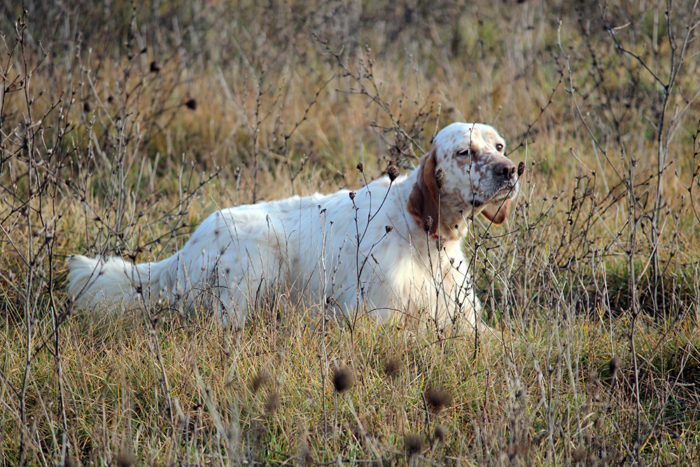
The Pointer, also known as the Lord of the Wind; the English Setter, the Italian Bracco, the Kurzhaar, the Drahthaar, the Epagneul Breton and the Italian Spinone.
Their purpose is to locate game, remain still or point towards it, thereby indicating its presence to the hunter.
Pointing dogs search for game by scent, working into the wind.
Pointing dog breeds are divided into three groups: Italian continental breeds selected in Italy, foreign continental breeds selected elsewhere in Europe, and English pointing breeds selected in the United Kingdom.
Most pointing dogs are used for hunting pheasants, partridges, quail, woodcock and snipe, and only rarely for hunting furred game such as hares.
Pointing dogs have been selected by humans over the centuries to develop a close bond with the hunter, based on collaboration and connection.
A pointing dog requires specific, professional training so that it remains steady rather than impulsive or aggressive, particularly when other dogs are present during a hunt.
You can learn more about the history and breeds of pointing dogs on the ENCI website.

Flushing Dogs
Examples include the Springer Spaniel, the Cocker Spaniel and the Labrador.
Dogs in this category have been selected to retrieve game after it has been shot by the hunter. They hunt by sight and display great sensitivity when retrieving their quarry.
Retrieving breeds must be capable of recovering shot game on both land and water. Training these dogs requires particular skills and equipment.

Hounds
Hounds are used to track and chase wild animals, mainly furred game, driving them towards the hunters.
These dogs pursue game by following a fresh trail and giving voice. All hounds belong to this group, including the Italian Hound.
Hounds are among the most ancient breeds. They are resilient, strong and hardy, tolerate fatigue well and generally adapt to any type of terrain.
The natural vocation of scent hounds is to hunt furred game, such as hares, roe deer, deer and wild boar, through four stages.
The first stage is the search; the second is the approach to the quarry; the third is the discovery; and the fourth is the pursuit.
These dogs are distinguished by their characteristic voices, whose tone varies by breed.
